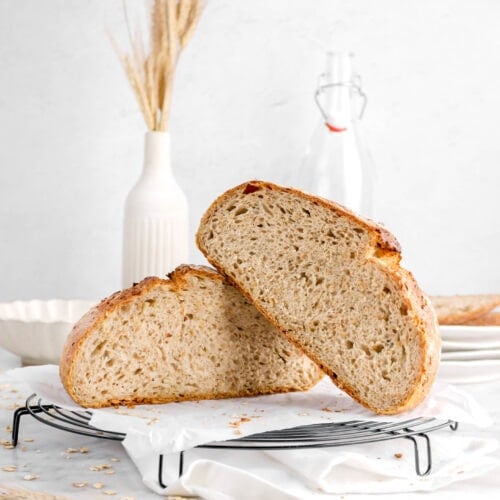
Multigrain Sourdough Bread
This Multigrain Sourdough Bread is a flavorful and versatile choice for breakfast, sandwiches, or dinner. It’s packed with wholesome ingredients and a delicious tangy taste you’ll love!
Servings: 12 slices
Calories: 133kcal
Ingredients
Whole Wheat Starter
- ½ cup sourdough starter
- ¼ cup water lukewarm
- ½ cup whole wheat flour
Soaker
- 2½ Tablespoons flaxseeds
- 2 Tablespoons steel cut oats
- 3 Tablespoons sunflower seeds
- 3 Tablespoons old fashioned rolled oats
- 1¼ teaspoons kosher salt
- ½ cup boiling water
Final Dough
- 1⅝ cups bread flour
- ½ cup water lukewarm
- ⅔ teaspoon instant yeast
- 1½ teaspoons kosher salt
- 1½ teaspoons honey
- All of starter
- All of soaker
Instructions
Whole Wheat Starter
- In a small glass bowl, whisk together starter and water.
- Stir in flour.
- Beat well.
- Cover with plastic wrap.
- Proof at room temperature (about 70℉/21℃) for 12-16 hours.
Soaker
- In a small glass bowl, stir together flax seeds, steel cuts oats, sunflower seeds, old fashioned rolled oats, and salt.
- Pour boiling water over the mixture.
- Stir until combined.
- Cover with plastic wrap.
- Allow to stand at room temperature for 12-16 hours.
Final Dough
- In the bowl of an electric mixer, combine bread flour, water, yeast, salt, honey, the starter, and the soaker.
- Mix on low speed for 3 minutes.
- Switch to dough hook, if using.
- Increase speed to medium.
- Continue to mix for 4-5 minutes, until the dough comes together and cleans the bowl.
- Turn into a clean glass bowl.
- Proof at 78℉/26℃ for 1-1½ hours, or until nearly doubled in bulk. (Cover with plastic wrap if not using a proofing box with a water tray.)
- Line a round banneton with a cover or a tea towel.
- Sprinkle with rice flour. Set aside.
- Turn dough out onto a lightly floured surface.
- Gently deflate.
- Fold the top third over toward the middle.
- Fold in the right and left corners.
- Roll dough towards you, tucking it tightly.
- Tuck ends under.
- Use a bench knife, or your hands, to round and tighten the dough.
- Place it, bottom side up, in prepared banneton.
- Proof at 80℉/27℃ for 1-1½ hours, until noticeably risen. (Cover with a tea towel or plastic wrap if not using a proofing box.)
- While loaf is proofing, heat oven to 450℉/230℃.
- If you are using a cloche to bake, put that in the oven now. If you are using a baking stone, put that in the oven along with an empty sheet pan or cast iron skillet on the rack below the stone.
- Turn loaf out onto a piece of parchment paper.
- Score, as desired.
- Place in cloche and replace lid or use a peel to slide onto stone. If using stone, pour at least 2 cups water into empty pan as soon as you put the bread on the stone.
- Close oven door immediately.
- Bake for 15 minutes.
- Lower temperature to 425℉/220℃. If using a cloche, remove the lid now.
- Continue baking an additional 30 minutes, or until loaf is done.
- Remove from oven.
- Place loaf on a wire cooling rack.
- Allow to cool completely, about 1½ -2 hours, before slicing.
Notes
- If you're new to sourdough and don’t have a starter, use our How To Make A Sourdough Starter in 5 Days guide!
- If you already have a sourdough starter, but it seems to be a little sluggish/doesn’t have that healthy smell, we recommend giving it about a week of really working to revive it. You can find out how to do this/get more tips in our Sourdough Starter Guide.
- Be sure to read through all the directions before beginning this recipe.
- Use a tea kettle to safely boil the water needed for the soaker.
- Do not use any roasted or salted nuts in this recipe.
- You will need old-fashioned (rolled) oats AND steel cut oats.
- Use glass bowls for the proofing.
- Rice flour works best to flour your banneton to prevent sticking.
- You can use a dutch oven, or a baking stone to bake this bread.
- If you are using a proofing box with a water tray, you will not need to cover the dough to proof it.
- Remember to preheat either the dutch oven or baking stone!
- To tell if the bread is properly proofed, press down gently on the top of the bread with a floured finger. If it springs back quickly, it needs to proof a bit longer. If it stays indented, it is over proofed. You can still bake it, and it will taste fine. It just won't be the pretty loaf you hoped for. If it springs back slowly, the bread is properly proofed and ready to cook.
- The bread is done when it sounds hollow if tapped on the bottom. A thermometer inserted into the loaf should read 205℉-210℉/96℃-99℃.
Nutrition
Serving: 1slice | Calories: 133kcal | Carbohydrates: 23g | Protein: 5g | Fat: 3g | Saturated Fat: 1g | Polyunsaturated Fat: 1g | Monounsaturated Fat: 1g | Sodium: 245mg | Potassium: 80mg | Fiber: 2g | Sugar: 1g | Vitamin A: 2IU | Vitamin C: 1mg | Calcium: 15mg | Iron: 1mg